
|
|
PRE-SYMPOSIUM - May 25 - 26, 2004
Universidad Javeriana, Cali
Purpose:
The purpose of the pre-symposium was to discuss the concept of restorative
justice within the context of Colombia, and after presentations by international
experts and discussions with national experts, to define the Agenda for
the February Symposium.
Goals and Objectives:
1. Be introduced to the conceptual framework of restorative justice
through presentations of the international experts invited
2. Become familiar with international examples and experiences
3. Discuss the concepts of transitional justice vs. restorative justice
and its applications
4. Discuss local experiences in restorative justice with international
experts
5. Begin an exploration of the articulation of restorative justice into
Colombia's current legal framework (both within a context of conflict
and post- conflict)
UP
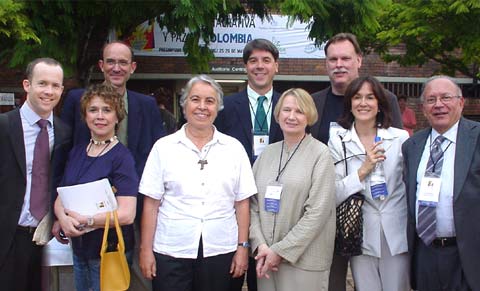
Speakers:
Louis Bickford, PhD, International Center for Transitional Justice, NY
Bio
Mari Fitzduff, PhD, Brandeis University Bio
Dr. Mauricio González, Director, Corporación Excelencia
en la Justicia Bio
Harry Mika, PhD, Central Michigan University Bio
Dr. Roberto Mora, Office of the High Commissioner for Peace, Universidad
Javeriana, Bogotá Bio
Declan Roche PhD, London School of Economics Bio
Dr. Oscar Rojas, Fundacion AlvarAlice, Cali Bio
Dr. Julio A. Sampedro, Universidad Javeriana, Bogotá
Professor Diana Britto Ruiz, Universidad Javeriana Cali
Bio
UP
Pre-Symposium Program
Restorative Justice and Peace in Colombia
Tuesday, May 25th
11:00 - 14:00 - Registration
14:00 - 14:40 - Opening Session: Sra. Lina Moreno de Uribe, First Lady
of Colombia, Dr. Angelino Garzón, Governor of Valle del Cauca,
Sra. María Eugenia Garcés E., Dr. Oscar Rojas, Fundación
AlvarAlice
14:40 - 15:10 - "Restorative Justice as Peacebuilding: Core Values,
Conceptual Frameworks, and Principles of Practice", Professor Harry
Mika PhD, Central Michigan University
15:10 - 15:30 - Q & A, Moderator, Dr. Oscar Rojas
15:30 - 16:10 - "The Need for Accountability Safeguards in Restorative
Justice", Professor Declan Roche PhD, London School of Economics
15:30 - 15:50 - Q & A, Moderator, Dr. Oscar Rojas
15:50 - 16:10 - (Coffee Break)
16:10 - 16:45 - "How Can We Articulate Principles of Restorative
Justice into the Colombia Legal Framework?", Dr. Mauricio González,
Director, Corporación Excelencia en la Justicia
16:45 - 17:10 - Q & A, Moderator, Dr. Julio A. Sampedro Universidad
Javeriana, Bogotá
17:10 - 17:30 - Wrap-up, Drs. Oscar Rojas and Roberto Mora
18:00 - 20:00 - Social Event
Wednesday, May 26th
Morning
8:30 - 9:10 - "Healing the Wounds of War? Restorative Justice in
Zones of Conflict" Professor Mari Fitzduff, PhD, Brandeis University
9:10 - 9:30 - Q & A, Moderator, Dr. Oscar Rojas
9:30 - 10:10 - Local Experience No 1 Programa Justicia Restaurativa- Casas
Francisco Esperanza, Cali. Hermana Alba Stella Barreto, Directora Fundación
Paz y Bien y grupo de Casas Francisco Esperanza
10:10 - 10:30 - (Coffee Break)
10:30 - 11:10 - Local Experience No 2 - Laboratorio de Paz del Magdalena
Medio, Padre Francisco De Roux, SJ y grupo de Laboratorio de Paz.
11:10 - 11:40 - Local Experience No 3 - Justicia Tradicional, Comunidad
Wayú, Antropólogo Wilder Guerra
11:40 - 12:10 - Local Experience No 4
12:10 - 12:30 - Q & A, Moderator, Dr. Oscar Rojas
12:30 - 13:45 - Lunch Break
Afternoon
13:45 - 14:45 - "Confronting a Violent Past: Democracy, Human rights,
and Transitional Justice"" Professor Louis Bickford, PhD, International
Center for Transitional Justice, NY
14:45 - 15:10 - Q & A, Moderator Dr. Roberto Mora, Office of the High
Commissioner for Peace, Universidad Javeriana, Bogotá
15:10 -16:45 - Round Table, National and International Speakers, Moderator,
Dr. Mauricio González, Director, Corporación Excelencia
en la Justicia
16:45 - 17:30 -Conclusions and Recommendations for the International
Symposium October 2004, Dr. Mauricio González Director, Corporación
Excelencia en la Justicia.
17:30 - Closing, Dr. Oscar Rojas
UP
______________________________________________________________
ABSTRACTS: PRE-SYMPOSIUM
Restorative Justice - Cali, May 25 & 26, 2004
1 - PROFESSOR HARRY MIKA, PHD, CENTRAL MICHIGAN UNIVERSITY
Presentation Title:
"Restorative Justice as Peacebuilding: Core Values, Conceptual Frameworks,
and Principles of Practice"
Tuesday, May 25th, 2:40 - 3:10 pm
Abstract:
This presentation attempts a basic overview of restorative justice, including
its general value orientation, the conceptual frameworks that help to
clarify it objectives and scope, and general principles to guide the work
of justice practitioners. These elements of restorative justice are proposed
within a peacebuilding context.
2 - PROFESSOR DECLAN ROCHE, PHD, LONDON SCHOOL OF ECONOMICS
Presentation Title:
'The Need for Accountability Safeguards in Restorative Justice"
Tuesday, May 25th, 3:30 - 4:10 pm
Abstract:
Restorative justice aims to repair harm and rebuild relationships by letting
victims, offenders and their communities decide in informal gatherings
how to deal with the aftermath of an offence. While results from many
restorative justice programs are promising, informal processes do not
necessarily produce restorative outcomes; they can also produce arbitrary,
oppressive and violent forms of justice. Communities can help guard against
this risk by ensuring that their restorative justice programs are accountable.
Accountability - the requirement that decision-makers explain and justify
their actions to others - is one of the most important checks on any system
of justice. Processes for justifying and scrutinizing decisions provide
decision-makers with an incentive to improve their decision-making, and
an opportunity to correct poor decisions. Moreover, accountable programs
are more likely to be accepted as legitimate. However, accountability
is not an unqualified good: accountability requirements can become too
burdensome, and destroy trust and goodwill. A survey of restorative justice
programs suggests that optimal accountability involves a combination of
informal and formal accountability mechanisms. Informal mechanisms include
peer review and the decision-making process in restorative meetings, while
more formal modes include external review of decisions taken in restorative
meetings, and openness to evaluation and audit.
3 - PROFESSOR MARI FITZDUFF, PHD, BRANDEIS UNIVERSITY
Presentation Title:
"Healing the Wounds of War? Restorative Justice in Zones of Conflict"
Wednesday, May 26th, 8:30 - 9:10 AM
Abstract:
Throughout the world, in e.g. Cambodia. East Timor, South Africa, Northern
Ireland, Rwanda, Sri Lanka, communities are exploring restorative justice
as a way of addressing intercommunal violence and the consequences of
community conflict. But can such approaches lead to reconciliation in
situations where there have been significant human rights abuses between
communities, and between governments and communities? What should be the
relationship between restorative justice processes, and the more formal,
and usually punitive, governmental and legislative approaches to justice
issues in situations of violent conflict? And what do such approaches
have to offer in assisting the development of successful peace processes
in conflicted countries?
4 - PROFESSOR LOUIS BICKFORD, PHD, INTERNATIONAL CENTER FOR TRANSITIONAL
JUSTICE, NY
Presentation Title:
Confronting a violent past: Democracy, Human rights, and Transitional
Justice
Wednesday, May 26th, 13:45 - 14:45 pm
Abstract:
Should societies confront the legacies of past human rights abuse, conflict,
or atrocity? If so, how? The emerging field of transitional justice seeks
to answer these questions. This presentation begins with an exploration
of why, or even if, societies should confront the past, drawing on arguments
about justice and democracy-building that have been advanced to support
the field of transitional justice. There will then be an examination of
the main strategies that have emerged for an engagement with the past.
These include (1) prosecuting the offenders, from Germany's Adolf Eichmann,
to Chile's General Pinochet, to Iraq's Saddam Hussein; (2) developing
Truth and Reconciliation Commissions (such as in Chile, South Africa,
Peru, and Sierra Leone); (3) establishing reparations programs; (4) launching
of larger-scale institutional reforms (such as police reform or security
sector reform in countries such as Northern Ireland, East Germany, and
Iraq); and (5) the building of memorials and recapturing public spaces
to create social dialogue (in Argentina, Cambodia, East Timor). A special
emphasis will be placed on the ways in which these multiple strategies
have interacted with each other.
UP
________________________________________________________________
PRE-SYMPOSIUM RESTORATIVE JUSTICE AND PEACE IN COLOMBIA
UNIVERSIDAD JAVERIANA CALI, MAY 25 - 26, 2004
CONCLUSIONS AND RECOMMENDATIONS
Prepared by Oscar Rojas, MD - Director, AlvarAlice Foundation, Cali
and Director of "Restorative Justice and Peace in Colombia"
Project, May 27, 2004
With an attendance of 150 people from different sectors of the academia,
public officials, civic and comunitary leaders, representatives of two
of the main indigenous communities, NGOs and CSOs, and considered by many
of them as an enormous success, the Pre-Symposium on Restorative Justice
and Peace in Colombia concluded on 26th of May in the Central Auditorium
of the Universidad Javeriana Cali, Colombia. The meeting was convened
and organized by the Universidad Javeriana Cali, the Fundación
Paz y Bien, the Fundación AlvarAlice and the Corporación
Excelencia en la Justicia.
The Pre-Symposium is the first in a series of two international meetings
that the convening organizations are calling together to advance the theme
of Restorative Justice in Colombia. During the Pre-Symposium various examples
and applications of Restorative Justice and traditional indigenous justice
were presented and discussed as well as the differences between Restorative
Justice and Transitional Justice within Colombia's current situation.
This February 2005 the second meeting will take place with a larger national
and international audience and will explore in greater depth the themes
introduced during the Pre-Symposium.
Through the presentation of both events, the convening organizations look
to provide a unique opportunity for research and study of applications
and models of Restorative Justice that might offer alternative approaches
for resolving conflict to the many groups and individuals, particularly
the youth, in Colombia that are caught in the middle of great violence.
Speakers included international scholar Declan Roche from the London School
of Economics, Harry Mika from Central Michigan University, Mari Fitzduff
from Brandeis University (Massachusetts), and Louis Bickford from the
International Center for Transitional Justice and Father Francisco de
Roux S.J., among others. The following conclusions were reached:
- Restorative Justice is a community-based justice which is associated
with programs of social and economic development. There is no one single
model that can be duplicated, rather each country or community develops
and implements models according to the local context and needs. However
certain characteristics are shared by all models:
1. It must have principles and normative structures that are collectively
defined.
2. It must have control and evaluation/accountability mechanisms that
make the process transparent and that enable constant learning and adjustment.
3. Restorative Justice operates within a democratic environment and offers
a valid strategy that advances and strengthens a society that is more
inclusive and fair.
- Speakers mentioned that in various parts of the world this type of justice
recovers traditional culture value-systems and knowledge. This was made
clear through the presentation of national examples of Restorative Justice
among the Wayu indigenous communities and the Nasa project of the Paeces
from the Cauca Region that demonstrated how within the Colombian context
many elements are already in place that support the application of this
type of judicial process.
- - Equally important, Prof. Declan Roche highlighted in his presentation
is the need for accountability and the need to clearly establish responsibilities
among all participants.
The Pre-Symposium served as a preparatory session for the main symposium
which will take place in February 2005. The following recommendations
were made with regards to the development of the Agenda for the next meeting:
- Restorative Justice has applications at a community level but also at
the state level, and this, according to various speakers, must be explored
in further depth at the next meeting.
- There was general consensus about the importance and potential for Restorative
Justice as a tool to further reconciliation and non-violent resolution
of conflicts. It was recommended that efforts were made to strengthen
and expand this kind of programs both in urban and rural areas.
- The current experiences/examples in Colombia require not only national
support and cooperation but also international support to promote consolidation,
transparency and accountability as well as expansion into other communities.
- It is necessary to create spaces for dialogue among the national experiences
to develop models appropriate and consistent with our own local needs
and context.
- The question that remains open is the relationship and differences between
Restorative Justice and Transitional Justice particularly in light of
today's recent legal developments in Colombia (new development regarding
the Law of Justice and Reparation and the code of penal procedures). These
questions need to be further developed and explored during the next meeting.
- It was also suggested that the convening organizations should work
together to come out with a proposal for a Statutory Bill that puts concepts
of Restorative Justice into practice, taking advantage of the clear references
to this communitary justice system already included in the Colombian Constitution
through the Legislative Act No 023 of 2003.The preparation of this Draft
Bill should be undertaken as a priority task within the time period from
the Pre-Symposium to the Symposium expected to be held in February 2005.
It is intended that the Draft Bill be presented for discussion to the
people attending the main event in February, prior to its submission to
the Colombian Congress in March 2005.
UP
PRESS
|
 |