



|
|
  
|
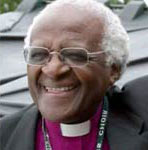
SPEAKERS AND BIOS ________________________________________________________ NOBEL PEACE PRIZE WINNERS ________________________________________________________ DESMOND MPILO TUTU ARCHBISHOP EMERITUS Desmond Tutu was born in Klerksdorp, South Africa, in 1931, son of a
After matriculating from the Johannesburg Bantu High School, he chose to follow his father’s career. He took a teacher’s diploma at the Pretoria Bantu Normal College and studied for his Bachelor of Arts degree at the University of South Africa. He was a teacher at the Johannesburg Bantu High School for a year and then moved to Munsieville High School, Krugersdorp for three years. It was here that he married his wife, Leah. They have three daughters, a son and several grandchildren. In 1958, following the introduction of Bantu education, the Archbishop decided to enter the ministry in the Church of the Province of Southern Africa and became an ordinand at St Peter’s Theological College, Rosettenville. He received his Licentiate in Theology in 1960 and was ordained to the priesthood in Johannesburg in 1961. Shortly afterwards he furthered his studies at the University of London, United Kingdom, where he obtained his Bachelor of Divinity Honours and Master of Theology degrees whilst a part-time curate in a local parish. In 1967 he returned to South Africa and joined the staff of the Federal Theological Seminary in Alice and became chaplain at the University of Fort Hare. In 1970 he moved to the University of Botswana, Lesotho and Swaziland where he held the post of lecturer in the Department of Theology. This step was followed by a further spell in the United Kingdom as Associate Director of the Theological Education Fund of the World Council of Churches, based in Kent. Tutu became Dean of St Mary’s Cathedral, Johannesburg, in 1975, but shortly thereafter was elected Bishop of Lesotho. By this time South Africa was in turmoil, in the wake of the Soweto uprising of 1976, and Bishop Tutu was persuaded to leave the Diocese of Lesotho to take up the post of General Secretary of the South African Council of Churches (SACC). It was in this position, a post he held from 1978-1985, that Bishop Tutu became a national and international figure. The SACC represented all the major Christian churches in South Africa,
apart from the Dutch Reformed Church and the Catholic Church (the latter
is, however, an accredited observer of the SACC). The SACC is committed
to the cause of ecumenism and to fulfilling the social responsibility
of the Church. Justice and Reconciliation feature prominently among its
priorities. As General Secretary, Bishop Tutu pursued these goals with
vigour and commitment. Under his guidance, the SACC became an important
institution in South African spiritual and political life that voiced
the ideals and aspirations of millions of Christians. The SACC was instrumental
in providing assistance to the victims Inevitably Bishop Tutu became heavily embroiled in controversy as he spoke out against the injustices of the apartheid system. For several years he was denied a passport to travel abroad, but in 1982 the South African government withdrew this restriction in the face of national and international pressure. The name of Bishop Tutu became synonymous with that of the SACC as he became the leader of the crusade for justice and racial conciliation in South Africa. In 1984, his contribution to the cause of racial justice in South Africa was recognised when he received the Nobel Peace Prize. In 1985 Bishop Tutu was elected Bishop of Johannesburg. In this capacity he did much to bridge the chasm between black and white Anglicans in South Africa. His office as Bishop of Johannesburg was of short duration, as in 1986 he was elected Archbishop of Cape Town. In electing him, the Anglican Church placed its trust in him as its spiritual leader and showed its confidence in his pursuit of racial justice in South Africa. In 1987 he was elected as President of the All Africa Conference of Churches. In the same year he was also elected a Fellow of Kings College, London and became Chancellor of the University of the Western Cape, a post that he still holds today. Before the unbanning of the African National Congress and other political
In 1995 President Nelson Mandela appointed Archbishop Tutu to chair South Africa’s Truth and Reconciliation Commission, the body set up to probe gross human rights violations between 1960 and the President’s inauguration in 1994. Archbishop Tutu and his fellow Commissioners presented the Commission’s Report to the President in October 1998. He retired from office as Archbishop of Cape Town in June 1996, but was named Archbishop Emeritus (an honorary title) from July 1996. In October 1998 he took a sabbatical at Emory University, Atlanta, where he was invited as the William R Cannon Professor of Theology at the Candler School of Theology, a position he held until July 2000. From February – May 2002 he has been Visiting Professor at the Episcopal Divinity School, Cambridge, Massachusetts and in January – May 2003 he was Visiting Scholar in Residence at the University of North Florida, Jacksonville. He holds honorary degrees from a large number of universities, including
Before 1990, Archbishop Tutu’s vigorous advocacy of social justice rendered him a controversial figure. Today he is seen as an elder statesman with a major role to play in reconciliation, and as a leading moral voice. Archbishop Tutu has become an icon of hope far beyond the Church and Southern Africa. He has retired and has a private office in Cape Town near his home His latest book, No Future Without Forgiveness, was honoured with the Book of the Year Award by the Association of Theological booksellers of the United States of America. December 2001 saw the same book receive the Sandro Onofri Prize, bestowed by the Council of Rome, Italy.
JOSE RAMOS HORTA Current positions: * Special Representative of the National Council of Maubere Resistance of East Timor. CNRM is a non-partisan supreme national body based inside East Timor comprising all East Timorese nationalist political forces and resistance groups. * Coordinator, East Timorese Resistance Diplomatic Front Coordinating Commission. * Executive Director, Lecturer Diplomacy Training Program, Law Faculty, University of New South Wales, Sydney, Australia. * Expert, International Service for Human Rights, Geneva. Past positions: * Minister of External Relations and Information, first provisional government of East Timor, prior to Indonesian invasion in 1975. * Permanent Representative to the United Nations for the East Timorese independence movement from 1975 onwards for over a decade. Major fora addressed: UN Security Council, Fourth Committee of the UN General Assembly, UN Special Committee on Decolonisation, UN Commission on Human Rights, Council on Foreign Relations, European Parliament, etc. Academic curriculum, writings, awards: Fellow, International Relations, St. Anthony's College, Oxford. Master in Peace Studies, Antioch University, USA. Attended the Hague Academy of International Law. Attended the International Institute of Human Rights, Strasbourg. Author of Funu: The Unfinished Saga of East Timor (200 pp), Red Sea Press, Trenton NJ (1987); TIMOR Amanha em Dili (386 pp), Dom Quixote (1994); 0st-Timor(264 pp) Aventura, Oslo (1966). Recipient of Professor Thorolf Rafto 1993 Human Rights Prize. Recipient Gleitzman Foundation Award 1995. Recipient of UNPO Award 1996.
RIGOBERTA MENCHU Rigoberta Menchú was born on January 9, 1959 to a poor Indian peasant family and raised in the Quiche branch of the Mayan culture. In her early years she helped with the family farm work, either in the northern highlands where her family lived, or on the Pacific coast, where both adults and children went to pick coffee on the big plantations. Rigoberta Menchú soon became involved in social reform activities through the Catholic Church, and became prominent in the women's rights movement when still only a teenager. Such reform work aroused considerable opposition in influential circles, especially after a guerilla organization established itself in the area. The Menchú family was accused of taking part in guerrilla activities and Rigoberta's father, Vicente, was imprisoned and tortured for allegedly having participated in the execution of a local plantation owner. After his release, he joined the recently founded Committee of the Peasant Union (CUC). In 1979, Rigoberta, too, joined the CUC. That year her brother was arrested, tortured and killed by the army. The following year, her father was killed when security forces in the capital stormed the Spanish Embassy where he and some other peasants were staying. Shortly afterwards, her mother also died after having been arrested, tortured and raped. Rigoberta became increasingly active in the CUC, and taught herself Spanish as well as other Mayan languages than her native Quiche. In 1980, she figured prominently in a strike the CUC organized for better conditions for farm workers on the Pacific coast, and on May 1, 1981, she was active in large demonstrations in the capital. She joined the radical 31st of January Popular Front, in which her contribution chiefly consisted of educating the Indian peasant population in resistance to massive military oppression. In 1981, Rigoberta Menchú had to go into hiding in Guatemala, and then flee to Mexico. That marked the beginning of a new phase in her life: as the organizer abroad of resistance to oppression in Guatemala and the struggle for Indian peasant peoples' rights. In 1982, she took part in the founding of the joint opposition body, The United Representation of the Guatemalan Opposition (RUOG). In 1983, she told her life story to Elisabeth Burgos Debray. The resulting book, called in English, I, Rigoberta Menchú, is a gripping human document which attracted considerable international attention. In 1986, Rigoberta Menchú became a member of the National Coordinating Committee of the CUC, and the following year she performed as the narrator in a powerful film called When the Mountains Tremble, about the struggles and sufferings of the Maya people. On at least three occasions, Rigoberta Menchú has returned to Guatemala to plead the cause of the Indian peasants, but death threats have forced her to return into exile. Over the years, Rigoberta Menchú has become widely known as a leading advocate of Indian rights and ethno-cultural reconciliation, not only in Guatemala but in the Western Hemisphere generally, and her work has earned her several international awards. _____________________________________________ INTERNATIONAL GUESTS _____________________________________________ ANTONIO BERISTAIN, S.J., Antonio Beristain, S.J., Catedrático E. de Derecho Penal, Universidad del País Vasco, Fundador y Director del Instituto Vasco de Criminología (1976-2000) (San Sebastián), Dr. Honoris Causa por la Universidad de Pau (Francia), Dr. Honoris Causa por la Universidad de Las Lomas de Zamora (Argentina), actualmente Presidente del Consejo de Dirección del Centro Internacional de investigación sobre la delincuencia, la marginalidad y las relaciones sociales (San Sebastián), se ha especializado sobre temas penales, criminológicos, penitenciarios y victimológicos. Premio Hermann Mannheim de Criminología Comparada (1993), Medalla al Mérito Social Penitenciario (1994), Medalla Félix Restrepo, S.J., Pontificia Universidad Javeriana (Colombia) (2001), Gran Cruz de la Orden de San Raimundo de Peñafort (2001), ‘X Premio de Convivencia' de la Fundación Profesor Manuel Broseta, y II Premio Internacional Covite - Víctimas del Terrorismo en el País Vasco - (2003). Profesor invitado en diversas Universidades europeas (Lovaina, Salzburgo) y americanas (Buenos Aires, México, Santafé de Bogotá). Ha publicado más de cuatrocientos artículos en revistas españolas y extranjeras, y más de treinta libros, como autor y como compilador, entre los que destacamos: Nueva Criminología desde el Derecho penal y la Victimología , Tirant lo Blanch, Valencia, 1994, 404 pp.; De los delitos y de las penas desde el País Vasco , Dykinson, Madrid, 1998, 344 pp.; Criminología y Victimología. Alternativas re-creadoras al Delito , Leyer, Santafé de Bogotá (Colombia), 1998, 324 pp.; Futura Política criminal en las Instituciones de Readaptación Social , Secretaría de Gobernación, México, 1999, 396 pp.; Victimología. Nueve palabras clave , Tirant lo Blanch, Valencia, 2000, 622 pp.; Protagonismo de las víctimas de hoy y de mañana (Evolución en el campo jurídico penal, prisional y ético), Tirant lo Blanch, Valencia, 410 pp.,, etc.
PETER BRUER Peter Bruer has a degree in political science from the University of
Toronto, was hired by St. Stephen’s Community House to run a landlord-tenant mediation project. In 1997 he became Manager of the Conflict Resolution Service, with responsibility for policy, program supervision and development of both its community and professional work. The Conflict Resolution Service is one of the largest and best-known community mediation services in Canada. Under Bruer’s direction the Service has doubled the scale of its work, and expanded into court-connected mediation, facilitation and team-building work and multi-cultural training, continuing the dynamic combination of free community work and paid professional services. Over more than 8 years in the field Bruer has acquired considerable personal
SOPHIE CHICHE SOPHIE CHICHE , Chief Operating Officer, offers extraordinary and futuristic leadership to IMPAQ.In this time of explosive global expansion,her international business experience brings an innovative and dynamic approach to growth and direction in the workplace. Sophie is not your typical CEO. Sophie is a hands-on “mission manager”, reaching and teaching everyone around her. She is the creative designer and effective overseer of the health and vitality of the company heartbeat. Sophie's European upbringing has instilled in her an unwavering commitment to a unified global economy, increased personal awareness and respect for the human spirit in the world. It is from these deep beliefs that she guides her life choices and effects meaningful change with our team,our clients, our vendors and individuals who are read y to thrive in their daily living. Sophie actively lives the principles of Personal Accountability advocated by IMPAQ's founder,Mark Samuel. Sophie and Mark have recently co-authored the international best-seller “ Personal Accountability,Achieving What Matters to You .” Sophie ensures that we at IMPAQ live what we teach,using the practice ofAccountability, in both long-term decision making and the mundane daily tasks.Through heart-centered leadership, Sophie guides the team to higher levels of excellence, achievement and leading edge business practices. As a proponent of individual improvement, Sophie continually increases our team expertise using ongoing training and development with cutting edge specialists. Through her unique experience as the U.S.Correspondent for the highly respected French magazine, Psychologies , Sophie has conducted extensive interviews with distinguished leaders in the human potential field, resulting in her knowledge of the latest breakthroughs. Her multi-faceted background and creative approach to business management is an ongoing inspiration to our valued family of clients and her ever growing readers. Sophie holds a Bachelors Degree in Business with a Marketing emphasis from ESIAE, Paris, France. She has also earned a Masters Degree of Applied Psychology from the University of Santa Monica, California.
MALCOLM DEAS University Lecturer in the politics and government of Latin America, Fellow of St Antony's College. His research has been mainly concerned with the history of Colombia, Venezuela and Ecuador in the nineteenth and twentieth centuries, though he is also interested in themes of Argentine and Mexican history. He is an advisory Editor of the Latin American Monograph Series, Cambridge University Press. He has published articles on Colombian, Ecuadorian and Venezuelan history (the history of coffee, civil wars, fiscal history, problems of regional history and politics, cultural history...), and has edited selections from the works of Eloy Alfaro and José María Vargas Vila. He has also published the Joseph Brown collection of watercolours of Colombia in the 1820s and 1830s - among the earliest known pictures of the country - under the title Types and Customs of New Granada. His Colombian articles have been published under the title Del poder y la gramática (1993) and his recent works are an essay on Colombian violence in David Apter's collection, The Legitimisation of Violence, London, Macmillan, 1997, and Vida y opiniones de Mr William Wills, 2 vols, Bogota, Banco de la República, 1996. He has also written on Anglo-Argentine relations and the Falkland Islands and is a member of the South Atlantic Council. He is a Corresponding Member of the Colombian Academy of History.
PUMLA GOBODO-MADIKIZELA Pumla Gobodo-Madikizela is associate professor of psychology at the University of Cape Town, and Senior Consultant for the Institute for Justice and Reconciliation in Cape Town. She completed her undergraduate studies at Fort Hare University, her Masters in Clinical Psychology at Rhodes University, and her Ph.D. in psychology at the University of Cape Town. She was on an extended research fellowship at Harvard University between 1998 and 2001 and was affiliated with the following schools and programs at Harvard: Radcliff Institute for Advance Research, Women and Public Policy Program, Carr Center for Human Rights Policy, and Harvard Divinity School. During this time, she taught at Wellesley College, Brandeis University, and Tufts University. She is a founder member of Women Waging Peace, a global initiative for women headquartered in Cambridge Massachusetts, whose members work in regions with a history of past and continuing conflict. Gobodo-Madikizela has been the recipient of many grants and awards, including an honorary Doctor of Law from Holy Cross College, Worcester Massachusetts in 2002. She has been nominated for social responsibility awards, such as the 2004 Reconciliation Award in South Africa, and scholarly awards such as the 2003 Award for Social Responsibility Research at Harvard University's Graduate School for Arts and Sciences. Gobodo-Madikizela is author of the critically acclaimed book, A Human Being Died That Night: A Story of Forgiveness, which has been published in the United States, South Africa, and The Netherlands. Gobodo-Madikizela recently received the prestigious Alan Paton Award for non-fiction for her book in South Africa, and the Christopher Award for adult non-fiction in the United States. Gobodo-Madikizela's current research interests include the psychology of forgiveness in the aftermath of mass atrocity, and trauma and gender issues related to HIV/Aids.
SALOMÓN LERNER FEBRES Estudios : Primaria y Secundaria : Colegio "La Salle" (Arequipa y Lima) Superiores : Pontificia Universidad Católica del Perú. Grado : Bachiller en Derecho Post-Grado : "Université Catholique de Louvain" (Bélgica). Grados : "Licencié en Philosophié" "Docteur en Philosophie" Docencia : -Pontificia Universidad Católica del Perú - 1962 a la fecha -Universidad Femenina del Sagrado Corazón - 1973-1978 -Universidad de Lima : 1973-1982 Experiencia Profesional : En la Pontificia Universidad Católica del Perú : -Director de la Revista Humanidades -Decano de Estudios Generales Letras -Jefe del Dpto. de Humanidades -Director Académico de Investigación -Vicerrector -Rector - Primer Período - 1994-1999 -Rector - Segundo Período - 1999-2004 -Diversas publicaciones y conferencias Cargos y Distinciones : Doctor Honoris Causa otorgado por la Universidad Nacional de Piura. Miembro Honorario del Colegio de Abogados de Arequipa. Diploma de Honor y Medalla al Mérito - Profesor Honorario - "Orden Daniel Hernández Murillo" de la Escuela Nacional Superior Autónoma de Bellas Artes del Perú.
PENUELL MADUNA Former Minister of JusticeMember ANC, NEC Former Deputy Minister of Home Affairs (1994 - 1996) Former minister of Mineral and Energy Affairs (June 1996 - June 1999) Penuell Maduna, was born in December 1952 in Johannesburg. His father died soon after Maduna was born. His grandmother was a card carrying member of the ANC thus at an early age Maduna was exposed to political issues. Maduna, a Zulu speaker matriculated from the Eshowe Government Bantu School in Natal in 1972 with the aid of a bursary he enrolled at the University of Zululand as a law student. In his first year Maduna was elected chairperson of the interim committee which had the task of reviving the Saso branch structures, he remained chairperson until 1974. On June 18th 1996 as part of a protest against the shooting of Soweto schoolchildren buildings at the university were set on fire. Maduna was arrested and detained from June 1976 until July 1997. He was tried under the Terrorism Act but was acquitted. Maduna was tried again for his ANC underground activities but was again acquitted in 1979. In 1980 Maduna left the country for Swaziland with the assistance of the ANC. In 1983 maduna was arrested and deported from Swaziland along with other members of the ANC. He then worked for the ANC in Mozambique, Tanzania and Harare where he completed his LLB degree at the University of Zimbabwe. While deployed at ANC headquarters in Lusaka, Zambia Maduna was founder member of the ANC's constitutional committee and as such was closely involved with the development of the ANC's constitutional guidelines from 1985 through the Harare Declaration in 1989, Codesa in 1991-92 and the negotiation process at the World Trade Centre in 1993. He also participated in virtually all the meetings the ANC had with white South Africans while the organisation was still banned. He was one of the first officials sent by the ANC to South Africa for talks about talks". He was a member of the ANC team at the Groote Schuur talks and at the DF Malan talks which reaffirmed the ANC's decision to suspend the armed struggle unilaterally. He co-authored with Azhar Cachalia the Fundamental Rights in the New Constitution which was published in 1994. During the Codesa phase of the negotiations Maduna completed his master degree through the University of the Witwatersrand. Maduna is a member of the board of the Faculty of Law at the University of the Witwatersrand. After the 1994 elections Maduna was appointed Deputy Minister of Home Affairs and in June 1996 was appointed Minister of Mineral and Energy Affairs. After the second democratic elections, June 1999, Penuell Maduma was appointed Minister of Justice and Constitutional Development.
JUAN ERNESTO MÉNDEZ Presidente, International Center for Transitional Justice, Nueva York Argentino-estadounidense. Presidente del International Center for Transitional Justice, Nueva York, a partir del 1 de junio de 2004. Asesor Especial del Secretario General para la Prevención del Genocidio (Naciones Unidas), desde el 1 de agosto de 2004. Profesor de Derecho, Universidad de Notre Dame (EEUU) y Director del Centro de Derechos Civiles y Humanos de su Escuela de Leyes (1999-2004). Miembro, Comisión Interamericana de Derechos Humanos (2000-2003) y Presidente, 2002-2003. Director Ejecutivo, Instituto Interamericano de Derechos Humanos, 1996-1999. Director de la división Américas y General Counsel , Human Rights Watch, 1982-1996. Preso político en Argentina, 1975-1977. Premios: “Jeanne and Joseph Sullivan” por servicios en el campo de los derechos humanos, Heartland Alliance, Chicago, 2003; Presidente Honorario, Centro de Estudiantes de Derecho, Universidad Nacional de Mar del Plata, Argentina, 2003; “Mons. Oscar A. Romero” por liderazgo y servicio a los derechos humanos, Universidad de Dayton, Ohio, 2000; “Rev. William M. Lewers, CSC” por servicios distinguidos en derechos civiles y humanos, Universidad de Notre Dame (EEUU), 1998; y otros. Autor de artículos y ensayos en temas de justicia de transición y del sistema interamericano de protección de los derechos humanos, entre otros. Co-compilador (con Guillermo O'Donnell y Paulo Sergio Pinheiro) de The (un)Rule of Law and the Underprivileged in Latin America , U. of Notre Dame Press, 1998, publicado también en castellano y en portugués.
FR. ELISEO R. MERCADO JR. OMI Father Mercado holds a rank of Professor V at Notre Dame University (Cotabato City). He teaches Peace and Development Studies in Graduate School and Islamic Studies in the undergraduate studies. He also chairs the Mindanao Leaders Coalition (Kusog Mindanaw) that unites all sectors in Mindanao to advocate for Peace and Development including the campaign for greater autonomy in Mindanao that includes campaign for Federalism. He is a well-known Mindanao Peace Advocate, and he was the chair of the National Citizens Movement for Free Elections (NAMFREL) in the Autonomous Regional of Muslim Mindanao (ARMM) from 1998 to 2002. He was President of Notre Dame University in Cotabato City (1992-2002) and the Notre Dame Educational Association (NDEA) (2000-2002) consisting of two universities, five colleges and 847 Secondary and Elementary Schools. He was the Assembly Floor Leader of the Southern Philippines Council for peace and Development (SPCPD) Consultative Assembly during the period of political transition following the Peace Agreement between the Philippine Government and the Moro National Liberation Front from 1996 to 2001. An expert on the role of Islam and the Peace Process in the Philippines, Father Mercado was designated Chairperson of the Independent cease-fire Monitoring Committee of the Philippine Government and the Moro Islamic Liberation Front (MILF). He was a World Bank Consultant in the evaluation and the redesign of the post agreement Social Fund phases one and two. He also serves as “advisor” to the Japanese Embassy on Mindanao. He is the chair of the National Peace Council that works for the resumption of the formal peace talks between the Philippine Government and all rebel fronts including the National Liberation Front. In 2002, he was a Fulbright New Century Scholar and spent a year at the Center for Muslim Christian Relations at Georgetown University in Washington DC. He is presently the Director of the Justice, Peace and Integrity of Creation for the Missionary Oblates of Mary Immaculate and its Main Representative as duly accredited NGO at the UN Department of Public In formation both in New York and Geneva.
DANIEL PECAUT Mr. Daniel Pecaut is a professor in Political Sociology at the Ecole des Hautes Etudes en Sciences Sociales (EHESS), Paris, France. Mr. Daniel Pecaut has a MA. from Ecole Normale Superieure (ENS), a Ph.D. from Ecole Pratique des Sciences Politique, , and is doctor honoris causa at the National University of Colombia. Mr. Daniel Pecaut has widely published on Colombia and has directed more than 20 Ph.D. dissertations on Colombia alone. ANDRES F. RENGIFO, PHD VERA INSTITUTE OF JUSTICE – NEW YORK Andrés Rengífo was born in Cali, Colombia and obtained his a double major in Economics and Political Science at the Universidad de los Andes in Bogotá. At present he is candidate for a Doctors degree in Criminal Justice (Ph.D.) in the City University of New York (CUNY). His dissertation is centered in the relationship between social networks and crime in the south part of the Bronx. He is a scholar of his own university and of the National Consortium on Violence Research (NCOVR). Andrés works as an Associated Researcher in the Vera Institute of Justice in New York since June 2003. In Vera, he has participated in various projects on the crimal and prison politics of the United States, financed by the National Institute of Justice. In the international field he has collaborated in the evaluation of the new justice system in Chile. Right now, Andrés is preparing various projects among which we want to emphasize an evaluation of the justice programs in Colombia and an other in which he wants to estimate the impact of the United States prison policy in the poorest communities.
DECLAN ROCHE, PHD Doctor Declan Roche is a Law Professor at the London School of Economics, where he is also member of the Mannheim Centre for Criminology. He has a degree in Law and Economics and a Doctorate in Law from the Australian National University, where he spent a sabbatical year in 2004. He focuses his teaching and research in the policies of the criminal justice system, in particular restorative justice. His publications on this subject include Responsibility in Restorative Justice (Oxford University Press, 2003), which won the Book of the British Criminological Society Award. In this book he examines the characteristics and the efficacy of those who carry out the restorative justice programs, using information from 25 programs from 6 different countries, including his own experience from symposiums his organized on the subject in South Wales, Australia. Recent publications include articles in the British Journal of Criminology and Economy and Society and an edited collection titled Restorative Justice (Ashgate, 2004).
JUSTICE ALBIE SACHS OF THE CONSTITUTIONAL COURT OF SOUTH AFRICA I was born in Johannesburg in 1935, but grew up in Cape Town where I went to school, to University, to the Bar and to Prison. (I was twice detained in solitary confinement for several months at a time under the security laws.) In 1966 I went to live in exile in London and did a doctorate at the University of Sussex. In 1977 I moved to newly independent Mozambique where I taught law and was director of research in the Ministry of Justice until 1988 when I was blown up by a bomb placed in my car by South African security agents. I lost an arm and the sight in one eye. After recovering from the bomb, I set up the South African Constitutional Studies Centre at the University of London. I returned to South Africa in 1990, after the ANC was unbanned and Nelson Mandela was released. As a member of the ANC Constitutional Committee I took an active part in preparing for the new Constitution, including the section dealing with amnesty and reconciliation. After South Africa's first democratic elections in 1994 I was appointed by President Nelson Mandela to the newly established Constitutional Court, of which I am still a member. My books include The Jail Diary of Albie Sachs, which was dramatised for the Royal Shakespear Company and braodcast by the BBC; Stephanie On Trail; the Soft Vengeance of a Freedom Fighter (which dealt with my recovery from the bomb and the eventual meeting of the person who organised the placing of the bomb in my car); and published just two months ago in September 2004, The Free Diary of Albie Sachs. I have also written books on the justice system in South Africa on Protecting and Advancing Human Rights and on Sexism and the Law.
MARK SAMUEL President, IMPAQ MARK SAMUEL is the President and Founder of IMPAQ and internationally acclaimed author of The Accountability Revolution,Achieving Breakthrough Results in Half the Time! As an Independent Consultant, Educator and Speaker since 1978, Mark has gained a farreaching reputation for his expertise in how Accountability can improve a company's bottom line. He teaches organizations of every stripe to thrive in the competitive 21st century global marketplace through results-oriented management based upon the practice of Accountability. Mark is considered a practical visionary by many Fortune 500 companies and has been recognized by CNBC, Bloomberg and Fortune Magazine, which cited him as a top authority on "how companies can end blame in the ranks and create a place where people want to work and get results." For the last 25 years,Mark has guided organizations across the globe to higher levels of long-term success.He is frequently called in by companies to address leaders on his unique approach to solving the challenges of culture change, performance improvement, leadership development and effectively managed teamwork.His personal objective is to ensure that his clients achieve meaningful and measurable breakthrough performance results that are sustained over time. Mark is an award-winning speaker in North and South America.He has addressed national conferences of ASTD, AQP, ODN,ASHHRA and ISPI. He moves audiences to effective action with engaging presentations that are inspirational,humorous, interactive, and thought provoking. He has inspired positive, profitable improvement in companies worldwide, including Chevron Corporation,American Express, Genentech,Mervyn's of California,Nissan Corporation, Hewlett-Packard Company, Universal Studios, Pacific Bell, The Royal Bank of Canada, Dura Pharmaceuticals,The University of California at Berkeley and PDVSA of Venezuela. Mark holds a Bachelors Degree in Social Science from the University of California, Irvine;a Masters Degree in Management, with a special emphasis in Organizational Development, from the University of California,Irvine;and a Masters Degree in Applied Psychology from the University of Santa Monica, California.
YASMIN SOOKA Yasmin Sooka is the director of the Foundation for Human Rights SA, which implements the EU human rights programme in SA. She was appointed by the UN office of the high commissioner for human rights to serve as an international commissioner for the Sierra Leone Truth & Reconciliation Commission. She has advised a number of truth commissions around the world. She was appointed in 1995 to the SA Truth & Reconciliation Commission as deputy chair of the human rights violations committee.Sooka serves on the council and senate of Wits University. She is a trustee of the Black Sash and a director on the board of the Centre for Conflict Resolution. Between 1992 and 1998 she was president of the World Conference on Religion & Peace. Between 1990 and 1992 she was a committee member of the National Co-ordinating Committee for the Repatriation of SA Exiles.
DANIEL VAN NESS Dan Van Ness is executive director of the PFI Centre for Justice and Reconciliation, a program of Prison Fellowship International. He has been active in criminal justice issues for over 30 years, as a lawyer, advocate, writer and teacher. Dan lived in and practiced poverty law for six years on the West Side of Chicago in the late 1970s. In 1981 he moved to Washington DC to work with Prison Fellowship Ministries, a faith-based organization working with prisoners, ex-prisoners, victims and their families. While there, he established and directed its criminal justice reform affiliate, Justice Fellowship. During his 11 years with Justice Fellowship, he organized lobbying activities on sentencing reform and victim rights issues, researched and wrote on restorative justice and helped start a victim assistance organization. After leaving Justice Fellowship and completing additional graduate study, he taught law in Detroit and criminology at the University of Malta where he lived for two years while helping the government overhaul its correctional system. Dan directs the PFI Centre for Justice and Reconciliation in providing programs, training and project management to advance the worldwide implementation of restorative justice. He led a development group in designing and implementing the Sycamore Tree Project®, a program that brings groups of victims into prisons for a series of meetings with groups of unrelated prisoners. He is currently adapting that for use with perpetrators and survivors of genocide in Rwanda. Dan represents PFI at international gatherings on restorative justice, and was a principal architect of the proposed Declaration of Basic Principles on the Use of Restorative Justice Programmes in Criminal Matters, currently under consideration by the United Nations for adoption. He has written a number of books and papers on criminal justice issues. His most recent book is Restoring Justice (2nd edition), co-authored with Karen Strong. He is an adjunct professor at Pepperdine University School of Law in California and at Hangdon Global University in the Republic of Korea. He has spoken and conducted training on restorative justice throughout the world. Dan is the General Editor of Restorative Justice Online. Leading Edge. Dan is currently leading a project to design a model restorative justice system that could deal with all matters currently sent through the criminal justice system. Such a system will need to: 1. Repair the harm done 2. Involve all the stakeholders 3. Transform the government/ community relationship
DR. WILLIAM F. VENDLEY, SECRETARY GENERAL William F. Vendley, Ph. D. has served as Secretary General of the World Conference of Religions for Peace /International ( Religions for Peace ) since 1994. Built on respect for religious differences, Religions for Peace is the world's largest multireligious organization solely dedicated to promoting collaboration among the world's religious communities around their deeply held and widely shared concerns. In Religions for Peace , he is a member of the Governing Board, which is composed of outstanding international religious leaders. He also serves as the organization's chief executive officer, overseeing the international secretariat in North America, Europe, the Balkans, West and East Africa, and Asia. He coordinates the international activities and projects of Religions for Peace's Interreligious Councils in 55 states around the world. Under Dr. Vendley's leadership, Religions for Peace and its local affiliates have helped to mediate violent conflicts in the Balkans, West Africa, and the Horn of Africa, supported and further engaged religious communities in collaborative work to assist the more than 12 million orphans of HIV/AIDS in Africa. Notable among the Religions for Peace developments during the tenure of Dr. Vendley's leadership is the first ever Global Network of Religious Women's organizations. The Network facilitates multireligious collaboration among religious women's organizations and mainstreams their leadership into Religions for Peace action programs. Dr. Vendley is a theologian and has served as a professor and dean in graduate schools of theology. He lectures frequently in academic, United Nations and NGO fora. He has been awarded several prizes for religion and human rights, and serves on the boards of a number of organizations ranging from the fine arts to those committed to peacebuilding. He holds a Doctor of Philosophy in Systematic Theology from Fordham University and a Master of Arts in Religious Studies from the Maryknoll School of Theology.
ELMAR G.M. WEITEKAMP Elmar G.M. Weitekamp studied Social work at the Hochschule Niederrhein in Mönchengladbach, Germany. After his studies he worked a couple of years as a juvenile court aide for the city of Mönchengladbach. After receiving a Fullbright scholarship he studied at the University of Pennsylvania in Philadelphia, USA under Marvin E. Wolfgang criminology and received his M.A. in Criminology in 1981 and his Ph.D. in 1989. In 1990 he started as a senior research associate at the Institute of Criminology, University of Tuebingen, Germany, where is stayed until joining the Faculty of Law at the KU Leuven in October 2001. His research interests are internationally oriented and he is a member of the Executive Board of the World Society of Victimology, the Scientific Commission of the International Society of Criminology, the chairman of the Scientific Committee of the World Society of Victimology, Co-Director of the Post Graduate Courses of Victimology, Victim Assistance and Criminal Justice. He serves and served on numerous boards of international committees, commissions such as a member of the European COST 18 Action on Comparing the Dynamics of Violence in Europe, heading the Steering Committee of the Eurogang group and serving as expert on the Sixth United Nations Survey of Crime Trends and Operations of Criminal Justice Systems. He further sits on the editorial boards of numerous journals, among them Justice Quarterly, Advances in Criminological Theories, and Policing: An International Journal of Police Strategies & Management. Current research projects include the study of processes of integration of former Russians in Germany, a cohort study in Wuhan, Peoples Republic of China, the emergence of gangs in Europe, processes of privatization in juvenile welfare and justice, the evaluation of victim-offender mediation programs in Germany and hate crimes. Prof. Weitekamp was a Visiting Professor in 1999 at the Department of Criminology, University of Melbourne, Australia and was appointed as Distinguished Adjunct Professor of Sociology at the Central China Normal University, Wuhan, Peoples Republic of China in September of 2000. Since 2001 he is Professor of Criminology, Victimology and Restorative Justice in the Department of Criminal Law and Criminology, Faculty of Law, University of Leuven, Belgium.
JEAN ZERMATTEN
President and Dean of the Court of Minors of the Canton of Valais Switzerland Main Professional Activities Jean Zermatten is President and Dean of the Court of Minors of the Canton of Valais (Switzerland) since 1980; he is also the founder y Director of the International Institute of Children’s Rights in Sion, Switzerland and was incharge of the courses of the Faculty de Letras, Social Work and Law at the University of Friburg. He began the Executives Masters on Children’s Rights, with the collaboration of the University of Friburg and the University of Kurt Böch. Other Activities to Point Out Commissioned by the Swiss Confederation to prepare the project for the first law on Penal Procedures for Minors. He received a mandate from the latin cantons of Switzerland in order to draft an international convenant on the application of measures for juvenile delinquents, which was accepted in October 2003. He has also collaborated in the creation of the first network of Swiss Children’s Rights, that brings together more than 50 Swiss NGO’s. He’s also presided the Swiss Society of Minors Criminal Law and the International Juvenile and Family Association. Recent Publications on Children’s Rights
Editions Saint-Augustin, Saint-Maurice, à paraître en septembre 2004 2004 Droits de l'enfant et SIDA : du tabou aux stratégies d'intervention. The rights of the child and HIV/AIDS : from taboos to intervention strategies 2003 Les Droits de l'Enfant. Et les filles ? 211 pages (Editeur) 2002 L'Enfant et la Guerre 162 pages (Editeur) 2002 Tribunal des Mineurs Le petit tailleur et autres histoires de galère Editions Saint-Augustin, Saint-Maurice 2001 Etrangers, Migrants, Réfugiés, Requérants, Clandestins… et les Droits de lEnfant? 244 pages (Editeur) 2000 100 Ans de Justice Juvénile : Bilan et Perspectives 315 pages (Editeur) 1999 Un Champion à Tout Prix. Les Droits de l'Enfant dans le Sport 155 pages 1998 Enfants et Travail. Une Coexistence Acceptable ? L'Approche des droits de Enfant 125 pages (Editeur) 1997 Une Convention, Plusieurs Regards. Les Droits de l'Enfant entre Théorie et Pratique 138 pages (Editeur) 1994 L'Archer Blanc, de la Dépendance à l'Initiation (avec PY Albrecht) Ketty and Alexandre Editions, Chapelle sur Moudon (Suisse) 1990 Nouvelles Tendances dans le Droit Pénal des Mineurs (avec F. Dünkel) Rapport Criminologique de l'Institut Max Planck, Freiburg i.B (Allemagne)
Algunos articulos significativos… Des droits de l'enfant et de quelques défis , in Journal de l'Organisation mondiale de l'enseignement préscolaire (France), août 2004 A la Santé des Enfants ! Evolution des droits de l'enfant et du droit à la santé, in La Santé, Cycle de vie, Société et Environnement, Réalités sociales, Lausanne 2004 L'intérêt de l'enfant, de l'analyse littérale à la portée philosophique Working report IDE, 2-2003, IDE La prise en charge des mineurs délinquants : quelques éclairages à partir des grands textes internationaux et d'exemples européens Revue de droit, Université de Sherbrooke, vol 34, 2003-04 La Justice des mineurs est-elle en danger ? Domaine Public, 27.09.2002 Les principaux instruments internationaux en droits de l'enfant Article pour la plateforme www.childsrights.org et littérature grise 100 años de Justicia juvenil, in Minoridad y Familia Delta Editora, 1997, Santa Fe, Argentine De quelques caractéristiques de l'intervention judiciaire face aux mineurs délinquants , RVJ 1996, Sion, Suisse Face à l'évolution des droits de l'enfant, quel système judiciaire : système de protection ou système de justice ? Revue internationale de criminologie et de police technique, n° 2, 1994 Genève Les objectifs du droit pénal des mineurs , RVJ 1995, Sion, Suisse Réflexion sur les réalités de la justice des mineurs et la séparation des fonctions judiciaires , RPS 107/1999, Berne, Suisse Révision des dispositions applicables aux mineurs in Jeunesse et Délinquance , Grüsch 1988, Berne, Suisse _________________________________________ FROM COLOMBIA _________________________________________
ANA TERESA BERNAL Ana Teresa grew up in a middle class family that suffered from many economic problems. As a young person she felt solidarity with street kids, but recognized that to help these young people by giving them food or inviting them into her home once in a while was not enough. She felt the need to do something more extensive to treat the problems and not just the symptoms. As a teenager she joined a leftist movement, but eventually became disillusioned, feeling that they were not addressing the country's needs properly. Furthermore she did not find violence to be the appropriate answer. In 1986, one year after the military took over the Palace of Justice and killed over 100 people who were lobbying for a cease fire, she founded the Movement for Life, an organization dedicated to promoting peace. Then, in 1992, she invented the idea of a national network for peace. Although there were many small initiatives for peace happening around the country at this time, no one had never brought them together before to create a stronger, more unified voice in favor of peace and non-violent resolution. Ana Teresa launched a national event against the war and from their continued her work consolidating the National Network of Peace Initiatives. Ana Teresa has become one of Colombia's best-known and most outspoken proponents of non-violent resolution to the civil conflict. In 1998 she won the Junior Chamber International Outstanding Young Persons of the World award for her Contribution to Children, World Peace and Human Rights. She is also the only person selected to represent civil society, young people, women, farmers and other under-represented groups, and one of few women on the National Thematic Committee. She will therefore be a highly involved and essential component in the negotiations between government and the FARC guerilla group. Though her high profile work and dedication to achieving peace in Colombia have led to many threats on her life (she was forced to leave the country for a few months in 1998), she is committed to making sure that the public has a voice in the country's decisions and to promoting peace and social justice in Colombia.
SENADORA CLAUDIA BLUM Claudia Blum nació en Cali, Colombia, en el hogar conformado por sus padres Harold Blum y Lili Capurro, y sus hermanos, Liliana y Harold. En la Universidad del Valle estudió psicología, carrera de la que se graduó en 1975 y luego se vinculó al Instituto Nacional de Educación Media Diversificada, INEM, de Cali, como psicóloga.Como periodista, Claudia Blum empezó a trabajar en el diario El Pueblo, de Cali, donde por 11 años se desempeñó como directora del suplemento infantil Pinocho, la revista Parejas y la revista cultural Contrastes. Fue luego directora del Festival de Arte de Cali entre 1986 y 1989, certamen cultural que revivió e hizo crecer hasta importantes dimensiones. En desarrollo de su gestión abrió las puertas de la cultura y de las artes a toda la comunidad, para que desapareciera el aire de privilegio que las caracterizó en otros tiempos.Claudia Blum continuó su formación y realizó un magíster en Estudios Políticos en la Universidad Javeriana de Cali entre 1989 y 1991.Empezó su actividad política como concejal de Cali durante el período 1984-1986 y luego, de 1990 a 1991, cuando se expidió la nueva Constitución. En 1991 llegó al Senado de la República, tercera en la lista de Andrés Pastrana. Hizo parte de la Comisión Quinta, y fue elegida vicepresidenta de ésta en 1992. Fue ponente de la ley que creó el Ministerio del Medio Ambiente, para otorgarle jerarquía política de primer nivel a un sector relegado por años a segundo plano y reorganizar todo el conjunto de instituciones que trabajaban en forma dispersa en este campo. “La creación de esta cartera se sustentó en la necesidad de trabajar por un desarrollo sostenible, que nos permita utilizar el entorno físico sin agotarlo y satisfacer las necesidades del presente sin comprometer la capacidad de las futuras generaciones de atender sus propias necesidades”, afirma. En el mismo año fue vicepresidenta de la Comisión Legal de Ética, donde le correspondió adelantar las investigaciones sobre irregularidades en las liquidaciones de varios empleados del Congreso.Fue elegida nuevamente senadora de la República en 1994, 1998 y 2002. A partir de 1994, hasta la fecha, ha hecho parte de la Comisión Primera del Senado. Ocupó su presidencia durante la legislatura 1999-2000. En este período se tramitaron importantes proyectos, tales como la prórroga de la Ley 418 que reglamentaba la extinta zona de distensión. También se tramitaron leyes que permitieron el otorgamiento de facultades al presidente de la República para agilizar trámites ante el Estado, y reformar la estructura administrativa de la Fiscalía, la Contraloría, la Procuraduría, la Registraduría y la Cancillería. También se aprobó la ley que busca racionalizar los gastos de funcionamiento de municipios y departamentos. Y se discutió el complejo proyecto de convocatoria a Referendo para reformar las costumbres políticas en el país. La lucha contra la corrupción ha sido uno de los propósitos que más la ha ocupado en su labor legislativa. “Se deben atacar frontalmente todas las formas de corrupción que malgastan el presupuesto y que deterioran la calidad de vida de los colombianos. Cada peso que se lleva un corrupto será un peso menos en beneficio de los necesitados”. Este propósito se ve materializado en proyectos como el Estatuto Anticorrupción, que se convirtió en ley; el Código de Ética del Congresista, derrotado en cuatro ocasiones; la iniciativa sobre financiación de campañas electorales; la reforma política, que define medidas contra el clientelismo, la corrupción electoral, y plantea cambios al funcionamiento del Congreso, así como el proyecto sobre transparencia estatal que facilita el control sobre las instituciones estatales. De igual manera, el proyecto que crea la Unidad Administrativa del Congreso para limitar prácticas corruptas en el manejo del Legislativo. Muchas otras de las iniciativas de Claudia Blum han logrado salir triunfantes en el Congreso. Es el caso de la Ley de Pedagogía electoral y constitucional en colegios y universidades, el acto legislativo que revive la extradición y el que eliminó la expropiación sin indemnización previa. Como ponente, impulsó la ya mencionada Ley 99 de 1993 que creó el Ministerio de Medio Ambiente; la Ley 282 de 1996 para sancionar los delitos contra la libertad personal, como el secuestro y la extorsión; la Ley 333 de 1996 sobre extinción de dominio; la Ley 360 de 1997 que modificó normas del Código Penal relativas a delitos contra la libertad y el pudor sexuales; la ley que creó los Jueces de Paz y el nuevo Código Penal que entrará en vigencia en el 2001.Claudia Blum ha escrito tres libros en los que refleja su trabajo en el Congreso y su posición frente a temas como medio ambiente, corrupción, participación ciudadana y cultura. Estos textos son: Ministerio del Medio Ambiente, última oportunidad (1993), Corrupción:¿Hasta Cuándo? (1995) y De Frente (1997).
DIANA BRITTO Colombiana. Magistra en Estudios Políticos de la Universidad Javeriana de Cali y Psicóloga en la Universidad del Valle. Actualmente es Directora del Programa de Ciencia Política de la Pontificia Universidad Javeriana de Cali. Su actividad como investigadora se ha centrado en los temas Justicia y Género. Desde hace cuatro años coordina el equipo de investigación sobre Justicia Restaurativa, en la Javeriana de Cali. Entre sus trabajos están: RESTORATIVE JUSTICE: A Road to Peace, ponencia presentada en la Universidad de Cambridge (Inglaterra) en el evento Transforming Unjust Structures. Capabilities and Justice (2003). Un capítulo en el libro Sexualidad y Género (Editorial la Manzana de la Discordia. 2002), titulado Planeación del Desarrollo con Perspectiva de Género. El Caso de Pereira: Comunas Ferrocarril y Altagracia (1998- 1999). Un capítulo en el libro TEXTOS Y PRÁCTICAS DE GÉNERO (Editorial la Manzana de la Discordia, Cali, Valle, 2004) titulado, Calle Luna, Calle Sol: las mujeres y las bandas en relatos de hombres. Así mismo, la Ponencia Justicia Restaurativa, una forma de integración y transformación social, presentado en el evento Reconciliación y Derechos Humanos: la noviolencia y la resistencia civil como instrumentos para la reconciliciación en Bogotá, Diciembre de 2004.
OBISPO SIJIFREDO DANIEL BUITRAGO PACHON . Formación: Licenciatura en Teología, Seminario Teológico Internacional. Cali, Colombia. Psicología Clínica Pastoral, Clínica Bautista de Barranquilla, Colombia. Teología Práctica, Escuela Luterana de Teología, San Leopoldo, Brasil. . Experiencia: 1983-1987 Vicario en comunidades indígenas y campesinas, Llanos Orientales de Colombia. 1988 – 1989 Capellán Colegio Los Ángeles, Bogotá, Colombia. 1989 – 2003 Pastor titular Iglesia Evangélica Luterana El Redentor, Bogotá, Colombia. 2000 Director del Servicio Luterano de Instrucción Teológica por Extensión. 2002 Profesor de Teología Práctica en la Escuela Luterana de Teología, Bogotá, Colombia. 2004 Obispo – Presidente Iglesia Evangélica Luterana de Colombia. . Participación en Eventos: Plenaria Coextensión Balboa – Panamá, 3-6 Junio 2002. Instituto Ecuménico UNAFIDES, Universidad Javeriana, Bogotá – Colombia, 2003. Fenomenologia Espiritual y Espiritista, San Leopoldo – Brasil, Octubre 2002. Reunión Obispos y Presidentes América Latina miembros de la Federación Luterana Mundial, San Leopoldo – Brasil, Marzo 2004.
FERNANDO CEPEDA ULLOA Fernando Cepeda (Colombia) has been University Professor since 1963 in the field of Political Science with an interdisciplinary view nourished by the US approach on Law and Philosophy. He has gathered vast experience in government both in domestic as well as international affairs. He served as minister of Government (1986) and communications minister (1987-1988). Ambassador in London and Ottawa and UN Permanent Representative –New York- and OAS Permanent Representative in Washington. He has comprehensive experience as radio, TV and press commentator. He is engaged in several international work teams inspired by the Inter-American Dialogue or the North South Center. He is Associate Fellow at St Antony’s College, Oxford University. Author of many Governability-related books (corruption, economic reform, political financing, decentralization, international relations, etc). At present, he is Professor of Political Science in the Business School of the Universidad de los Andes, Bogota.
MARIA EUGENIA GARCES María Eugenia Garcés Campagna and her siblings are the founding members of Fundación Alvaralice, an organization working towards breaking the cycles of poverty and violence that plague Colombian society by creating opportunities and facilitating partnerships between local and national organizations and corporations that effectively mobilize resources and forge strong, working alliances. Fundación Alvaralice is one of the organizations behind the upcoming International Symposium on Restorative Justice and Peace in Colombia, to take place in Cali, February 9 – 12, 2005. The Symposium will gather international and national experts to discuss the principles of restorative justice and their potential application in the ongoing peace process. Notable speakers will include President Alvaro Uribe of Colombia, and Nobel Peace Prize winners Archbishop Desmond Tutu, Rigoberta Menchu and Jose Ramos Horta. The Foundation also supports programs such as FUNDCOMA (Fundación Colombiana para el Manejo de Trauma Cerebral), which provides education and training for medical and ambulatory personnel dealing with traumatic brain injury patients, and the Francisco Esperanza Project, which provides workshops and vocational training programs for at-risk youth. Mrs. Campagna is also a board member of Fundación Corona, a private foundation based in Colombia, focusing on education, healthcare, and community development initiatives, and which is presently involved in several projects, among them various joint ventures with The Ford Foundation and the International Bank for Development. She and her family are members of The Synergos’s Global Philanthropists Circle. Mrs. Campagna is a native of Cali, Colombia and is married to David W. Campagna. She has two daughters, Gabriella (18) and Giovanna (15).
LIBIA GRUESO Libia Grueso, a social worker and co-founder of the Process of Black Communities (PCN), is one of the most prominent intellectual-activists in the Afro-Colombian civil rights movement. In the early 1990s, together with other movement leaders, she led a campaign that secured more than 5.9 million acres in territorial rights for Colombia’s black rural communities. Grueso is now focused on protecting Colombia’s Pacific rainforest, a region facing the escalating threat of armed conflict, environmental ruin, and the mass displacement of Afro-Colombian villagers.
MAGDALENA LEON . Socióloga-feminista. Profesora titular de la facultad de Ciencias Humanas de la Uniersidad Nacional de Colombia en Bogotá ( Jubilada). Ha sido profesora visitante en las universidades de Columbia y Sussex y en otras e Madrid, Santo Domingo y Lima, Quito y México Además de varias distinciones, en el año 2000 recibió el Premio Nacionbal al Mérito Científico en la categoría de Investigador de Excelencia de la Asociación para el Avance de la Ciencia en Colombia. Fue directora de las investigaciones que dieron origien a los libros “La mujer y el desarrollo en Colombia” ( 1977) y Mujer y capitalismo agrario” (1980). Ha editado los libros colectivos: “Debate sobre la mujer en América Latina y el Carribe” (1982) ( tres volunes), “Poder y empoderamiento de las mujeres” (1997), ”Participación política de las mujeres: Avances y desafios”(1997), y coeditado “génerto e identidad: Ensayos sobre lo femenino y lo maculino (1995). Con Carmen Diana Deere es coatora de “Women in andian agriculture: Peasant production and rural wage empl0yment in Colombia y Perú” 1982), “Genero, propiedad y empoderamiento: Tierra, estado y mercado en A.L” ( 2000) que recibio el premio LASA al mejor libro en 2003 y de numerosos artículos y coeditoras de “ La mujer y la política agraria en América Latina” (1986). Es consultora internacional.
BEATRIZ LONDOÑO La Dra. Beatriz Londoño, actual directora del Instituto Colombiano de Bienestar Familiar, entidad nacional encargada de asuntos de familia y niñez en todo el país, es médica de la Universidad Pontificia Bolivariana, especialista en anestesiología y reanimación de la Universidad de Antioquia, con Maestría en salud pública de la Universidad de Harvard. La Dra. Londoño ha concentrado toda su carrera en el sector social, particularmente en lo concerniente a la seguridad social y la asistencia a las poblaciones más vulnerables. Durante los últimos diez años se ha desempeñado, entre otros, como asesora del Ministerio de Salud y Secretaria de Salud de Bogotá. Ha sido asesora de la Dirección Nacional de Planeación y el Ministerio de Hacienda, así como de organismos internacionales, alcaldías y entidades privadas. Durante su gestión al frente del Instituto Colombiano de Bienestar Familiar ha liderado con otras instituciones de carácter público, así como organizaciones de la sociedad civil, el proyecto legislativo que discute el Congreso de la República, el cual debe conducir a la actualización del marco legal que rige para los adolescentes infractores de la ley penal. En dicho proyecto, la justicia restaurativa se contempla como una opción que el juez podría siempre considerar para evitar en lo posible la privación de la libertad de adolescentes infractores, permitiendo así que no sean revictimizados, a la vez que las personas y comunidades afectadas puedan ser resarcidas, sobre la base de un proceso donde prime la verdad y el ánimo de reparación de todas las partes involucradas.
JUAN MAYR Colombia's Juan Mayr has led a brilliant crusade for the world's highest coastal mountain - the Sierra Nevada de Santa Marta. Rising abruptly from the beaches of the Caribbean to 18,947 feet, the Sierra Nevada is a striking example of Colombia's phenomenal biodiversity. Every type of ecosystem is represented - arctic tundra, rainforest, desert - and like the larger world, it is imperiled. A photographer turned environmentalist, for two years Mayr made his home in the Sierra Nevada and lived with the Kogi -one of the last functioning pre-Colombian civilizations. The Kogi, who live in villages high on the slopes of the Sierra Nevada, worship knowledge and believe that they are the "Elder Brother" of Mankind. They feel responsible for keeping the balance of the universe and view the rest of mankind as the "Younger Brother" who through ignorance and greed is killing the Great Mother (Earth). The Kogi, who Mayr now promote as exemplary managers of the environment, have resolved to have minimal contact with the outside world. In 1986 Mayr founded the Fundación Pro-Sierra Nevada de Santa Marta and served as its executive director. Using his great communication skills, Mayr has worked hard to develop a participative conservation strategy to bring together regional government, peasant farmers, indigenous peoples, scientists, local and international conservationists and different armed groups that operate in the region for the mountain's conservation. After four years of meetings, workshops and consultations, the Fundación Pro-Sierra Nevada de Santa Marta developed a participatory conservation development plan for the area. In June 1994, after 500 years of struggle, 19,500 hectares of traditional lands on the Caribbean coast were returned to the indigenous peoples of the Sierra Nevada by the Colombian government. Over 300 Kogi, Arsario and ArhuacoIndians walked down from the mountain to the sea to attend this historic event.In August 1998 Mayr was appointed minister of the environment by the Colombian President Andres Pastrana. Mayr has had to resign as the director of the Fundación Pro-Sierra Nevada de Santa Marta, but remains an active board member.
ANGELIKA RETTBERG Angelika Rettberg es la directora del Programa de Investigación sobre Construcción de Paz del Departamento de Ciencia Política de la Universidad de los Andes. Obtuvo su título doctoral de Boston University en el 2000. Sus investigaciones han abordado al sector privado en tanto actor político y, más recientemente, se han centrado en el comportamiento del sector privado en contextos de conflicto armado y enfrentado a tareas de construcción de paz. Ha publicado diversos libros y artículos sobre estos temas en revistas nacionales e internacionales.
GENERAL JUAN SALCEDO LORA . ACTIVIDAD DOCENTE Profesor de Táctica, Estrategia, Artillería de Campaña, Historia Militar e Inteligencia en varios centros docentes. . CURSOS Estado Mayor Alta Gerencia ESAP DIH San Remo, Italia. Diplomado Sociología Relaciones Internacionales y Fronteras, CIDE, Diplomado en DDHH, Socio Geopolítica y DIH, CIDE Especializado en Sociología Relaciones Internacionales, DDHH y solución Conflictos, CIDE. . CARGOS MAS DESTACADOS: Comandante Batallón, Brigada y División Director Inteligencia del Ejército Director Escuela Superior de Guerra Agregado Militar Washington Agregado Militar Roma . COMISIONES ESPECIALES: - TRATADO DE NO PROLIFERACION DE ARMAS NUCLEARES, Ginebra, Suiza, en Junio de 1985.. - PRESIDENTE COMISION REDACTORA CODIGO PENAL MILITAR.1995.. ACTIVIDADES Y TRABAJOS LITERARIOS: .Miembro de número Academia Colombiana Historia Militar Cofundador Centro Estudios Estratégicos e Históricos FFMM Miembro Número Sociedad Santanderista de Colombia Miembro Número Sociedad Bolivariana de Colombia . AUTOR 0 COAUTOR DE LAS OBRAS: .Ni connivencia, ni ruptura (1986) ¿Quiénes son los responsables? (1994) ¿Al fin que, obedecemos o no? (1995) Autodefensas y grupos paramilitares (1995) Alternativas para un Proceso de Paz - (1997) Operaciones Multinacionales de Paz (1995) Coordinación guerrillera en Colombia (1995) Autor de la obra ¨ Terrorismo en Italia: Brigadas Rojas ¨ (1985) Conflicto Amazónico 1934/1994, (1994) Coautor Historia de la Artillería Colombiana, (1997) Coautor Historia de los Uniformes Militares de Colombia, (1998) Coautor Reconocer la guerra para reconstruir la paz, (1998) Coautor Guerra, Violencia y terrorismo, (1999) Coautor . PRESIDENT OF COLOMBIA, ALVARO URIBE VELEZ Click here for more information.
LEON VALENCIA Escritor y periodista. Especialista en temas de paz, conflicto y derechos humanos. Columnista del diario El Tiempo. Libros más recientes: Adiós a la política, bienvenida la guerra. Intermedio Editores 2002. Miserias de la guerra, esperanzas de la paz. Intermedio Editores 2003. La novela Con El Pucho de La Vida. Editorial Alfaguara 2004.
DARIO VILLAMIZAR HERRERA Politólogo. Amplia experiencia en gestión, evaluación, puesta en marcha y ejecución de proyectos alrededor de los componentes paz, derechos humanos y derecho internacional humanitario, investigación histórico-política y resolución-transformación de conflictos. Profesor de las Universidades Javeriana y Central en las áreas de negociación y resolución de conflictos. Es el caso de la gestación, conformación y consolidación del Observatorio para la Paz, ONG sin ánimo de lucro, constituida por personas tanto provenientes de la insurgencia que posteriormente dejaron las armas, como de la institucionalidad. En este mismo sentido participa en el proceso de convocatoria y concertación que permitió constituir la Corporación Medios para la Paz conformada por periodistas y personalidades comprometidas con un sentido ético y responsable del ejercicio informativo. En el caso de este escenario, donde también confluyen diferentes opiniones y tendencias, la labor se ha concentrado en la puesta en marcha de proyectos que permitan una mejor calificación de los periodistas colombianos, particularmente de las provincias. Como escritor ha tenido amplio reconocimiento nacional e internacional, sus libros son textos de estudio en varias universidades del país, de utilidad para estudiantes de ciencia política, resolución alternativa de conflictos, cultura de paz y derechos humanos. Ahora, al frente de la Asociación Latinoamericana para los Derechos Humanos dirige proyectos relacionados con la situación de los derechos humanos de los pueblos indígenas.
|
 |
|||||||||||||

|